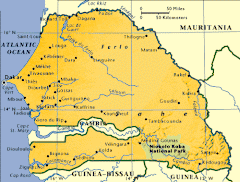
I did find quite a bit that was helpful. I don't want you to think that I found it all bad. There were some very helpful things that they presented, things that would help us in Senegal build bridges even further than we have with language and culture learning and adaptation. It reminds me of some things I learned in my studies at Toccoa Falls College.
One thing that is very important is love. There was a story that I heard while at TFC that has stuck with me. There were two missionaries serving in West Africa among the same people group in the same area. One of the missionaries was a gifted language learner. He learned the local language very fast. The other missionary was not as gifted. He struggled with the simplest of tasks in the local language, yet he deeply loved the people. He served them with all his heart. Furlough time came for the two. The church wrote the mission and said, "_________ is really gifted in our language, but he does not love us. __________ struggles with our language, yet he serves us everyday and he loves us. Please keep _____________ (the first missionary) and send us ___________ (the second missionary) for he loves us."
I share that story because loving the people is basic to bringing the Gospel to a community. If you do not have love, all the strategy in the world will do you little good (1 Cor. 13:1-3). Love involves serving. Serving involves availability and vulnerability, two concepts that brings fear to the strongest part of self service and pride. We really want to get back to Senegal to serve the Wolof people.
This conference has really made my desire to return to Senegal that much more acute. I really feel the need to get back and work with the team of missionaries that is forming as they plan their strategy (they are meeting now) and really move ahead in reaching the Wolof for Christ. Please pray with us that our financial and prayer support would come in quickly. Thanks!
Wednesday, January 28, 2009


The Conference on Contextualization
My heart is heavy with grief as I write today (Sat). I have just returned from the contextualization conference. I’m grieving because what they taught today was heresy and so many accepted it. All week during the conference I was finding things to be somewhat helpful (some of the things they were talking about we already do in Senegal and there were some helpful tools) and somewhat harmful. Their perspective was that if people were Muslim or Hindu or whatever, then they should remain Muslim, Hindu or whatever, all while trusting in the atoning work of Jesus on the cross. They would then be “in the Kingdom” (of God). I say that it is harmful because that has already been tried in Senegal with various organizations and found to be divisive of the church. I could not agree with that as well because it will lead to syncretism, that is the blending of two or more belief systems. We observe syncretism in Senegal everyday as there are aspects to the Wolof belief system that originate from their traditional religion (spirit worship). You can imagine a follower of Jesus who has blended his family’s belief system with the new belief system of Jesus as Savior. This is bad missiology (the practice of taking the Gospel cross-culturally). Although it is heretical, it is more “indirect heresy” if you know what I mean.
What I found heretical is the following quotation from a scholar named Drummond, “My own judgment is that I see Muhammad as an authentic prophet of God, even though like other prophets after the time of our Lord, neither morally perfect nor doctrinally infallible”. The speaker in the conference then read Ephesians 4:11 and asked rhetorically, “I wonder why could we not call Muhammad a New Testament prophet?” I am ashamed to say that I didn’t refute him publically as I should have. I simply got up and left. I was just so shocked. Anyway, I shed my name tag and left as close to tears as I’ve ever been.
I understand what Paul felt as he said of the false teachers that had confused the Galatians, “11And I, brethren, if I still preach circumcision, why do I still suffer persecution? Then the offense of the cross has ceased. 12I could wish that those who trouble you would even cut themselves off!” (Gal. 5:12, NKJV) That “cut themselves off” actually refers to the idea of not being able to spiritually reproduce. Please forgive me for being so frank with you all, but you should know that I plan on being frank on this blog. I hope that you don’t mind.
I did find some helpful tools at the conference. Also, I was challenged to study the Scriptures deeply to make sure that my methods are rooted in Scripture rather than my own traditions. This should be a constant challenge for any cross-cultural worker. So thanks for praying.
What I found heretical is the following quotation from a scholar named Drummond, “My own judgment is that I see Muhammad as an authentic prophet of God, even though like other prophets after the time of our Lord, neither morally perfect nor doctrinally infallible”. The speaker in the conference then read Ephesians 4:11 and asked rhetorically, “I wonder why could we not call Muhammad a New Testament prophet?” I am ashamed to say that I didn’t refute him publically as I should have. I simply got up and left. I was just so shocked. Anyway, I shed my name tag and left as close to tears as I’ve ever been.
I understand what Paul felt as he said of the false teachers that had confused the Galatians, “11And I, brethren, if I still preach circumcision, why do I still suffer persecution? Then the offense of the cross has ceased. 12I could wish that those who trouble you would even cut themselves off!” (Gal. 5:12, NKJV) That “cut themselves off” actually refers to the idea of not being able to spiritually reproduce. Please forgive me for being so frank with you all, but you should know that I plan on being frank on this blog. I hope that you don’t mind.
I did find some helpful tools at the conference. Also, I was challenged to study the Scriptures deeply to make sure that my methods are rooted in Scripture rather than my own traditions. This should be a constant challenge for any cross-cultural worker. So thanks for praying.
Subscribe to:
Posts (Atom)